

Yellow jacket removal comes down to one job: finding the nest, treating it at the right time of day, and sealing the spot so the colony does not return. The part that goes wrong is the nest you cannot see, such as a ground burrow or a wall void. Those are the nests behind most bad stings. If wasps are crossing your yard, entering a wall or guarding a hole near your door, call a licensed pest professional. At Ben’s Pest Control in Port St. Lucie, we start every job with a free 58-point pest analysis, and our treatments are child and pet friendly.
TL;DR
- Yellow jackets are black-and-yellow wasps, about ⅜ to ⅝ inch long. They often nest underground or inside walls, so the nest is frequently hidden.
- Colonies can reach 5,000 workers or more by late summer. Disturbing a large nest is how most people get stung many times.
- Nests in walls or attics, and any nest near someone with a known sting allergy, should be removed by professionals.
- Treatment is done at night, when foragers are back in the nest. It takes days to take full effect, and the entrance is sealed afterward.
- Call 911 right away for breathing trouble, swelling of the face, lips or tongue, dizziness or hives after a sting.
Table of Contents
- Is it a yellow jacket? What the nest looks like
- Why a hidden nest is the real risk
- When to call a professional
- What professional yellow jacket removal involves
- What about do-it-yourself treatment?
- Staying safe until the nest is gone
- Keeping yellow jackets from coming back
- Getting it handled on the Treasure Coast
- FAQ
- Sources
Is it a yellow jacket? What the nest looks like
Yellow jackets are often confused with honey bees and paper wasps. University of Maryland Extension describes them as black-and-yellow wasps, ⅜ to ⅝ inch long. Their nests are wrapped in a gray-brown paper envelope. That is the first thing that separates them from the open, umbrella-shaped comb of a paper wasp.
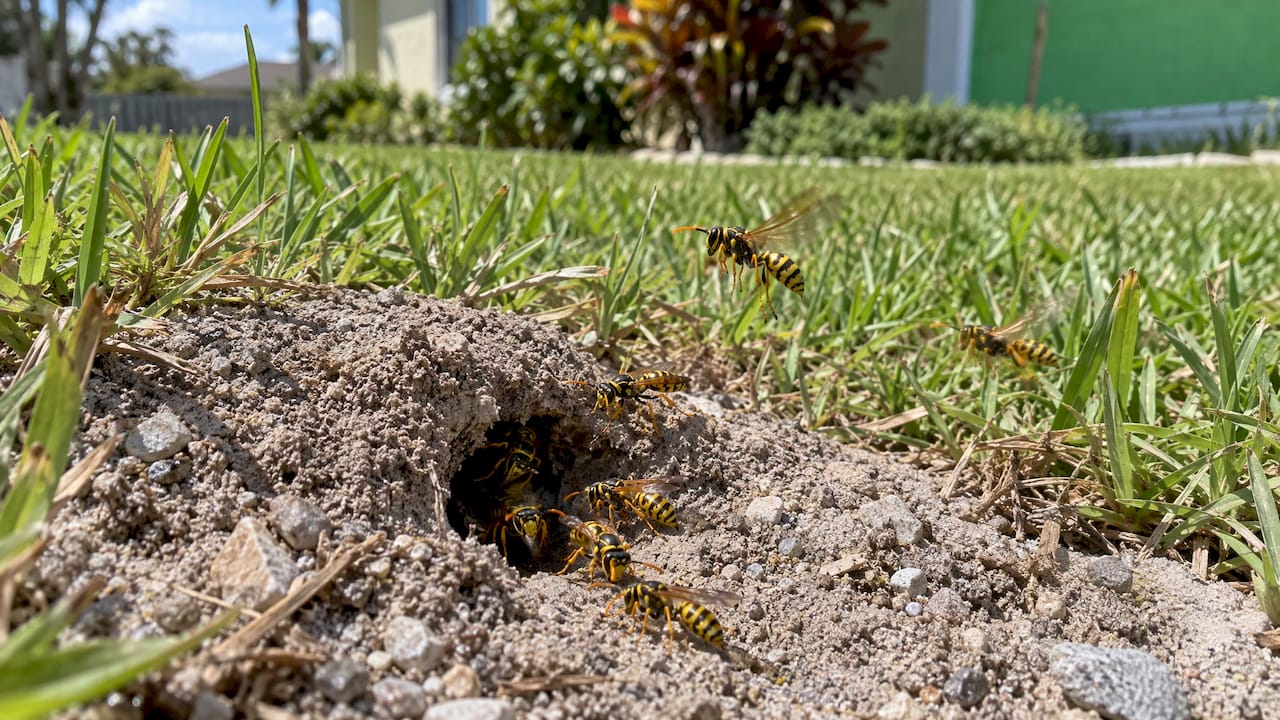
Where the nest sits matters more than what it looks like. Cornell’s integrated pest management program notes that yellow jacket nests are multi-tiered combs inside a rounded paper shell. They are built in voids such as tree hollows, structural walls and abandoned burrows, or in the open in trees and under eaves. Alabama Cooperative Extension adds that the entrance hole is typically about the size of a nickel. Underground nests sit in old rodent or animal burrows, often with small stones and dirt piled at the opening. Above-ground nests turn up in eaves, attics, wall voids, crawlspaces, hollow logs, stumps and even recycling bins.
If you see a steady stream of wasps going in and out of a single hole in the ground, a gap in siding, or a crack near a vent, you are most likely looking at the entrance to a colony.
Honey bees are a different job
If the insects are fuzzy, rounder and gathered in a swarm or a hive, you may have bees, not yellow jackets. Bees call for a different approach, and we handle that through our bee removal service. If you are unsure which you have, describe what you see when you call and we will help you sort it out.
Why a hidden nest is the real risk
A yellow jacket nest starts small in spring with a single queen. By late summer it can hold thousands of workers. That growth is why timing matters. Cornell’s guidance is to deal with young nests soon after they start, before many workers are present. Most homeowners discover a nest much later, when it is already large and defensive.
Several things make large nests dangerous:
- They defend aggressively. Mowing near a nest, hitting a wall or tree that holds one, or shining a light at the entrance can all set off the colony, according to Maryland Extension.
- Underground nests are bigger than the hole suggests. UC Integrated Pest Management notes that underground nests can extend far from the visible entrance. A spray at the opening may never reach the colony.
- Store-bought sprays are not guaranteed. The same source says even freeze-type aerosols are not guaranteed to stop all wasps, and that professional help is the easiest and safest route to removing a nest.
- Children and pets get stung repeatedly. Oregon State University warns that children and pets may be stung many times, and that children are at risk if they handle a pressurized insecticide can.
Seasonal timing is also worth knowing. Yellow jackets are most active between about 10 a.m. and 4 p.m. and forage within roughly 1,000 feet of the nest, per the Marin/Sonoma Mosquito and Vector Control District. In northern states the colony dies after the first hard freeze, and Nebraska Extension says a nest that is bothering no one can be left alone for that reason. Florida winters are mild, so do not count on a freeze to solve a nest near your door or driveway.
When to call a professional
Some situations are not worth any risk. Penn State Extension says nests in a home’s walls or attic should always be treated by professionals. It also says people with known sensitivities to wasp and bee stings should have nearby nests removed by professional pest management personnel. Call for removal when:
- The wasps are entering a wall, soffit, attic, crawlspace or shed.
- The nest is in a lawn, flower bed or path where children or pets play, or near a door, patio or pool.
- You cannot see where the wasps are going, so the nest has not been located.
- Anyone in the household has been stung before and had a strong reaction, or has a known allergy.
- The nest is large, which usually means late summer and fall.
- You manage a rental, an HOA common area or a business, where guests and tenants cannot be told to keep clear.
Property managers have an added reason: a documented removal and follow-up visit protects tenants and customers. If you are unsure whether a pest problem is the landlord’s or the tenant’s responsibility, our guide on landlord pest duties on the Treasure Coast explains the basics.
Sting allergy: know the warning signs
Most stings are painful and nothing more. A small number of people have a severe allergic reaction. Oklahoma State Extension reports estimates of 50 to 100 U.S. deaths per year from insect stings and says at least 2.5 million Americans have some increased sensitivity to stinging insects. Severe reactions can begin within 10 to 30 minutes of a sting, and most reported deaths happen within an hour.
The East Bay Regional Park District lists the warning signs of anaphylaxis: trouble breathing, hives, swelling of the face, lips or tongue, dizziness or faintness, nausea and a weak, rapid pulse. It instructs readers to call 911 immediately. A peer-reviewed review in Allergy, Asthma & Clinical Immunology states that epinephrine is the drug of choice for this kind of reaction. If you or a family member has ever reacted strongly to a sting, see an allergist about testing and a prescription epinephrine kit. The Oklahoma State authors note that doctors cannot reliably predict who will have a life-threatening reaction on the next sting.
What professional yellow jacket removal involves
A good removal is a short sequence, and every step exists for a reason. Here is how it works, and where each step tends to go wrong when it is rushed.
1. Find the nest and every entrance
Wasps are easiest to follow in the daytime. The Marin/Sonoma district’s method is to look after 10 a.m. for a constant “bee line” of wasps, or a cluster guarding an opening. The nest is then marked from a distance, never touched. Nests can have more than one entrance, which is why a treatment aimed at the wrong hole fails and leaves an angry colony behind.
This is where our free 58-point pest analysis fits. It is a thorough inspection of your property, so the treatment plan matches what is actually on site instead of what is easiest to see.
2. Treat at night, with the right gear
Nebraska Extension explains that the best time to find a nest is during the day, but the best time to treat is after dark, when the foragers have returned. Applicators wear protective clothing over the body, face and hands and use a red light, which the wasps cannot detect. The same source warns never to plug a wall-void hole before treatment. Sealed in, the wasps will chew their way out into the living space.
This is the step that most often hurts people. Daylight treatment means a nest full of foragers, and a flashlight beam at the entrance can provoke an attack. Maryland Extension also calls home remedies such as flooding a burrow or setting a nest on fire ineffective, and they raise the risk of stings.
3. Apply a product labeled for the job
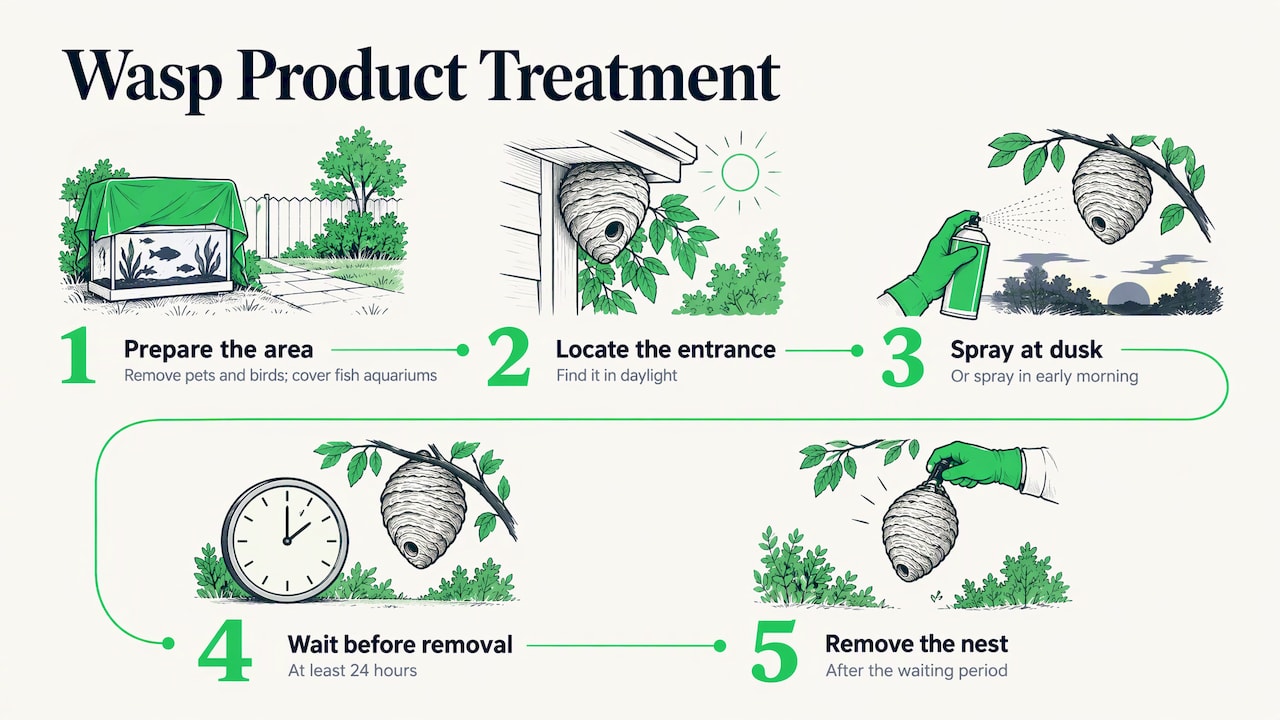
In the U.S., pesticide labels are legally binding instructions. Labels for wasp products in current EPA registration repeat the same themes. One EPA-registered wasp and hornet label dated September 2025 says adults, children and pets must stay out of the treated area until sprays have dried. It also requires that pets and birds be removed and fish aquariums covered before spraying. For yellow jackets, it says to locate the entrance in daylight, spray at dusk or early morning, and wait at least 24 hours before removing the nest.
Professionals working structural nests commonly use dusts and sprays placed into the entrance. Oklahoma State Extension describes a dust applied into the opening, followed by a spray, with the entrance then plugged and the site watched for a few days. If activity continues, treatment is repeated.
At Ben’s, our treatments are child and pet friendly, and our licensed technicians apply them. You are not left to read a label at dusk with a nest humming a few feet away.
4. Expect a few days, then a follow-up
Treatment does not kill every wasp at once. Maryland Extension says the full effect can take several days, because residues have to reach the workers as they come and go. Wasps from the nest that are out foraging will return and contact the treated entrance. You may see more activity near the nest for a day or two. That is normal, and it is the reason keeping everyone away from the area matters during that time.
Follow-up matters. If wasps are still active after the first visit, the nest has another entrance, or it is larger than it looked. Our follow-up treatments are backed by a money-back guarantee if treatment is not effective within 30 days.
5. Remove or seal the remains
Once activity stops, the entrance is sealed. University of Nebraska guidance says to close it with soil, wood or caulk so wasps do not re-establish there. Maryland Extension adds that remnants of an inactive nest inside a wall should be removed, because dead larvae can attract flesh flies and rodents. An old outdoor nest in a tree can usually be left in place.
The rodent point is a real one in our area. If you have noticed rodent activity near the same spot, ask us about rodent removal and exclusion. The same gap in a foundation or soffit that lets wasps in may be an entry point for other pests.
What about do-it-yourself treatment?
University extension offices publish do-it-yourself instructions, and you will find plenty of videos too. The consistent message across them is caution. Penn State’s instructions call for long sleeves, rubber gloves, goggles and a dust mask, then laundering clothes and showering right after. Nebraska says that if you cannot locate the nest, you should not use insecticide at all. Cornell recommends consulting an expert when an active colony poses a stinging risk to people and pets.
Put those requirements next to the facts above: a nest you cannot see, hundreds or thousands of defensive wasps, the need to work in the dark, and a child or pet who may wander over afterward. For most households, hiring a licensed technician is the more sensible way to remove the nest. It is also the only choice for a nest inside a wall.
Staying safe until the nest is gone
While you wait for your appointment, a few habits reduce the risk. They come from the East Bay Regional Park District and Maryland Extension guidance:
- Keep children and pets away from the area, and do not mow near the nest.
- Do not swat at wasps or hit the wall, tree or ground where the nest is.
- Do not shine a light at the entrance or try to block it.
- Cover outdoor food and drinks. Check a soda can or cup before you sip, since wasps crawl inside.
- Skip perfume and brightly colored clothes when wasps are around, and do not go barefoot.
- Bring pet food and dishes indoors, and remove toys from the yard.
If you are stung and develop any of the anaphylaxis signs described above, call 911. Do not wait to see whether symptoms improve.
Keeping yellow jackets from coming back
Removal ends one colony. Prevention reduces the odds of the next one. Each year a new queen looks for a sheltered spot, and the following measures make your property less attractive.
- Seal entry points. Oregon State recommends sealing structures and blocking entry to stop yellow jackets from nesting inside or under buildings. Check soffits, vents, siding gaps and the base of sheds.
- Remove food sources. Maryland Extension advises removing sugary drinks, candy, fruit and meat, especially in autumn. Cover outdoor food, rake up fallen fruit and use trash lids that fit tightly.
- Use wasp-tight bins. Nebraska guidance recommends solid waste receptacles with wasp-tight lids.
- Fill abandoned burrows. Underground nests often move into old rodent holes, so dealing with rodents also removes nesting sites.
- Walk the property in spring. Cornell notes young nests are the easiest to deal with. A quick look in March and April along eaves, sheds and burrows catches problems early.
Our pest control maintenance visits cover the exterior of your home on a regular schedule. That makes it more likely a small nest is spotted early. Our overview of integrated pest management explains the approach of combining inspection, exclusion and targeted treatment.
Getting it handled on the Treasure Coast
If you have wasps going in and out of the ground, a wall or a soffit anywhere in Port St. Lucie, Stuart, Palm City, Fort Pierce, Vero Beach, Jensen Beach or Hobe Sound, our team can help. Ben’s Pest Control is family owned, with more than 30 years of experience, and you have direct access to the owner when you call. We begin with a free 58-point pest analysis to confirm what you are dealing with and where the nest is. Treatments are child and pet friendly, and our follow-up treatments are backed by a money-back guarantee if treatment is not effective within 30 days.

To book an inspection, start with our pest control page. Homeowners, property managers and businesses can all use it. You can also learn more about our local pest control team before you call.
FAQ
How do you get rid of yellow jackets fast?
The fastest safe route is locating the nest and having it treated at night, when the wasps are inside. Even then, full results take several days, because the treatment has to reach the workers as they come and go. Anything that promises an instant fix usually means disturbing the nest in daylight, which is when stings happen.
What do exterminators use for yellow jackets?
Professionals typically apply insecticide dusts and sprays directly into the nest entrance, then plug or seal the opening. Oklahoma State Extension describes a dust followed by a spray, with a check of the site over the next few days and a repeat treatment if wasps are still active. Products must be used according to their EPA-registered labels.
Where do yellow jackets go when their nest is destroyed?
Workers that are away when the nest is treated return to the site and are exposed to the treated entrance, which is why activity can continue for a few days. Sealing the entrance afterward helps prevent a new colony from settling in the same spot. Nests are not reused year to year, but a new queen can choose the same sheltered spot.
Does dish soap and water kill yellow jackets?
Soapy water can kill the individual wasps it contacts, but it does not reach a colony hidden underground or in a wall. Getting close enough to a nest to use it also puts you in the path of defending wasps. For a nest, a licensed professional is the safer choice.
Sources
- How to Find an Underground Yellowjacket Nest, Marin/Sonoma Mosquito and Vector Control District
- Social Wasps: Yellowjackets, Hornets, and Paper Wasps, University of Maryland Extension
- Yellowjackets and baldfaced hornets, Cornell IPM
- Lookout for Yellow Jackets, Alabama Cooperative Extension
- Paper wasps and Yellowjackets, Nebraska Extension
- Eastern Yellowjacket, Penn State Extension
- Yellowjackets, Oregon State University
- Yellowjackets and Other Social Wasps, UC IPM
- Paper Wasps, Yellowjackets and Other Stinging Wasps, Oklahoma State Extension
- Living with Yellow Jackets, East Bay Regional Park District
- Management of Insect Sting Hypersensitivity: An Update
- EPA pesticide product label, wasp and hornet killer, September 2025
Recommended


